



When a congregation decides to invest in new or updated church seating, the conversation usually starts with wood finish, pew style, or layout. Fabric tends to come up later, almost as an afterthought. But anyone who has managed a sanctuary renovation and watched upholstery wear out years ahead of schedule knows that fabric selection is one of the most consequential decisions in the entire project.
This guide is for facilities managers, building committees, rabbis, church administrators, and anyone else responsible for making seating decisions that need to hold up for decades. We’ll walk through fabric types, what makes them suitable or unsuitable for worship environments, and the questions you should be asking long before you approve a sample.
Why Fabric Choice Matters More in Worship Settings Than Almost Anywhere Else
Church and synagogue seating faces a specific and demanding set of conditions that most commercial environments don’t. Think about what happens on a typical Sunday or Shabbat morning. Hundreds of people sit down and stand up repeatedly. Hymnals and prayer books are set on laps. Children fidget. Elderly congregants lower themselves slowly. Someone arrives in a wet coat.
Then multiply that by fifty-two weeks a year, year after year, for the next twenty or thirty years.
There’s also the question of cleaning. Sanctuary seating often gets spot-cleaned rather than professionally deep-cleaned on a regular schedule, which means whatever fabric you choose has to be forgiving when someone wipes it down with a damp cloth or a general-purpose cleaner. Some fabrics hold up beautifully under that treatment. Others degrade quickly or trap stains in ways that become permanent.
Good fabric selection isn’t just about how something looks on day one. It’s about how it looks on day three thousand.
The Most Common Fabric Types, Honestly Evaluated
Polyolefin (Polypropylene)
This is one of the most reliable options available for worship seating, and it’s worth understanding why. Polyolefin is a solution-dyed synthetic fiber, which means the color is part of the fiber itself rather than applied to the surface afterward. That distinction matters enormously for fade resistance, especially in sanctuaries with large stained glass windows or significant natural light exposure.
Polyolefin fabrics are also inherently moisture-resistant and don’t absorb staining agents the way natural fibers can. They tend to clean up well with mild soap and water, which makes day-to-day maintenance far less stressful for facilities staff.
The trade-off is texture. Polyolefin can sometimes feel less luxurious than woven wool or high-end blends. However, manufacturers have made significant improvements in the softness and visual appeal of polyolefin over the past decade. Today’s options can look and feel quite refined while still delivering the durability that high-use environments demand.
For synagogue benches and church pews that will see daily or multiple-service-per-week use, polyolefin is difficult to beat from a long-term value standpoint.
Commercial-Grade Woven Fabrics
Not all woven fabrics are created equal. The term “commercial-grade” gets used loosely, so it’s worth knowing what to look for. When evaluating a woven fabric for pew or chair upholstery, the most important number to ask about is the rub count, measured by the double-rub test (also called the Wyzenbeek test or Martindale test, depending on the standard used).
For residential furniture, fabrics rated at 15,000 double rubs are considered durable. For worship seating, you generally want to look for fabrics rated at 100,000 double rubs or higher. Anything below that is likely to show premature wear in the areas people sit and stand most frequently, particularly the seat edge and front of the cushion.
Woven fabrics in wool or wool blends can be excellent performers when the weave is tight and the rub count is high. They tend to handle light soiling gracefully, and they carry a warmth and richness that synthetic fabrics sometimes struggle to match visually. They are, however, more demanding to clean properly and can be more sensitive to moisture.
Velvet and Cut Pile Fabrics
Velvet looks stunning in a sanctuary. The problem is that it often doesn’t stay that way.
Cut pile fabrics, including velvet, are prone to crushing in high-use areas. You’ve probably seen this on older church pews: the seat looks threadbare or patchy not because the fabric has worn through, but because the pile has been compressed unevenly over years of use. The areas where people sit most heavily look noticeably different from the rest of the cushion.
Velvet also tends to be more challenging to clean without leaving water marks or affecting the pile direction. For a sanctuary that holds one service per week and has a small, consistent congregation, velvet might be manageable. For a busy church with multiple services on Sunday plus midweek programs, it’s typically not the right choice.
Microfiber
Microfiber fabrics have improved considerably and now appear in some commercial-grade options with respectable rub counts. They are generally soft, easy to clean, and fairly stain-resistant. The concern with microfiber in worship settings tends to be long-term structural integrity. Some microfiber fabrics begin to pill or develop a surface texture change over time that looks worn even when the fabric itself hasn’t actually failed.
If you’re considering microfiber, ask your manufacturer specifically about long-term performance in high-use seating applications and request references or project examples where that fabric has been in use for five-plus years.
What Goes Under the Fabric Matters Just as Much
Fabric durability is only one part of the equation. The foam underneath plays an equally important role in how upholstered seating holds up over time and how comfortable it remains.
Standard foam will compress and lose its shape relatively quickly under repeated use. High-density foam maintains its structure much longer and provides more consistent support. For worship settings, high-density foam is strongly recommended, particularly for seating that will be used multiple times per week.
The thickness and composition of the foam also affects comfort during extended services. A thinner, lower-density foam might feel adequate during a short visit, but congregants who attend longer services or multiple services per week will notice the difference. Seating that becomes uncomfortable discourages engagement and, honestly, can affect how people feel about returning.
Color and Pattern: The Practical Considerations
Choosing fabric color is partly an aesthetic decision and partly a practical one. A few things worth thinking through:
Darker colors hide soiling better but can show lint and pet hair (yes, this matters for churches that host community events and memorial services). Lighter neutrals can look more open and inviting but require more diligent cleaning.
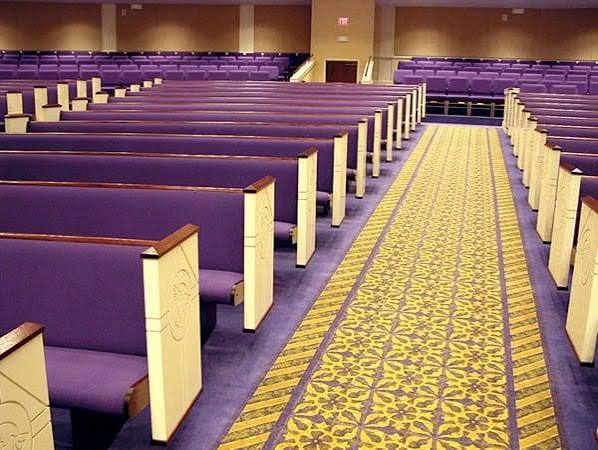
Patterns and textures tend to mask uneven wear more effectively than solid fabrics. A subtle tone-on-tone weave, for example, will look more consistent across years of use than a flat solid, where any variation in pile or sheen becomes immediately visible.
Colorfastness is essential in any sanctuary with significant sunlight exposure. Always ask about UV resistance when reviewing fabric options, particularly for seating positioned near windows.
Questions to Ask Before You Approve a Fabric Sample
Before finalizing any upholstery selection for your sanctuary, here are the practical questions worth raising with your manufacturer or design consultant:
- What is the rub count, and what test method was used?
- Is this fabric solution-dyed, or is the color applied to the surface?
- What is the recommended cleaning method, and is it practical for a facilities team to perform without professional equipment?
- How does this fabric perform with bleach or disinfectant cleaners, which may be used periodically?
- Has this fabric been used in other church or synagogue seating applications, and can you show examples?
- What is the warranty on the upholstery, and does it cover fading or wear?
These questions accomplish two things. They give you genuinely useful information for your decision. They also reveal how well your manufacturer or supplier understands the specific demands of worship environments.
A Note on Reupholstering Existing Pews
If your project involves updating existing pews rather than replacing them entirely, fabric selection becomes even more critical. Reupholstering is an investment you want to last. The structural condition of the pew frame and the quality of the foam replacement will influence how long the new upholstery holds up, but so will the fabric itself.
This is also an opportunity to update a sanctuary’s look significantly without a full renovation. Thoughtful fabric selection, when paired with a refinished wood frame, can make decades-old seating look and feel entirely new.
The Bottom Line
Upholstery selection deserves the same level of attention as every other element of a sanctuary renovation or new build project. The fabric you choose will be touched, sat on, and cleaned thousands of times before you revisit the decision. Getting it right the first time protects your investment, keeps your congregation comfortable, and reduces the maintenance burden on your facilities team for years to come.
Work with a manufacturer who understands the environment, can speak to long-term performance honestly, and has experience in church and synagogue projects specifically. The difference between a knowledgeable partner and a general furniture supplier often shows up years after the install, when the fabric is either holding strong or starting to fail.